
Have you ever finished writing a draft of your book, only to ask yourself, “Now what?”

Maybe you've stared at your 50,000+ words, wondering which parts work, which don't, and how to transform this draft into something publishable.
I’ve been there. It once took me more than a year to even begin to figure out what was wrong with my book. And I know from so many writers in our community, who have invested months or even years into finishing their draft, but then weren’t sure what to do next.
The usual answer is to get feedback, ideally from a developmental editor or otherwise from beta readers or friends and family.
The problem is that developmental editing is expensive, usually starting at $1,500 or more, and it takes weeks or even months to get your feedback.
That's what’s exciting about Twig.io. If you haven’t heard of Twig yet, it’s a new virtual developmental edit that will deliver professional-level feedback on your book’s content in just 30 minutes or less at about one-tenth of the cost of traditional editing.
The question is, of course, can an AI tool really give you the kind of quality feedback that will help you get your book ready for publishing? And how does it compare to human developmental editing?
In this post, I'm sharing my Twig dev edit review to help you decide if this virtual developmental edit could become the first step after you finish your book.
But first, I do want to be fully transparent and let you know that I believe in this product so much that I’m now working with the team at Twig to build it! Of course, that won't affect your overall price, but I did want to be clear that this isn’t an entirely unbiased review. Now, let's jump in!
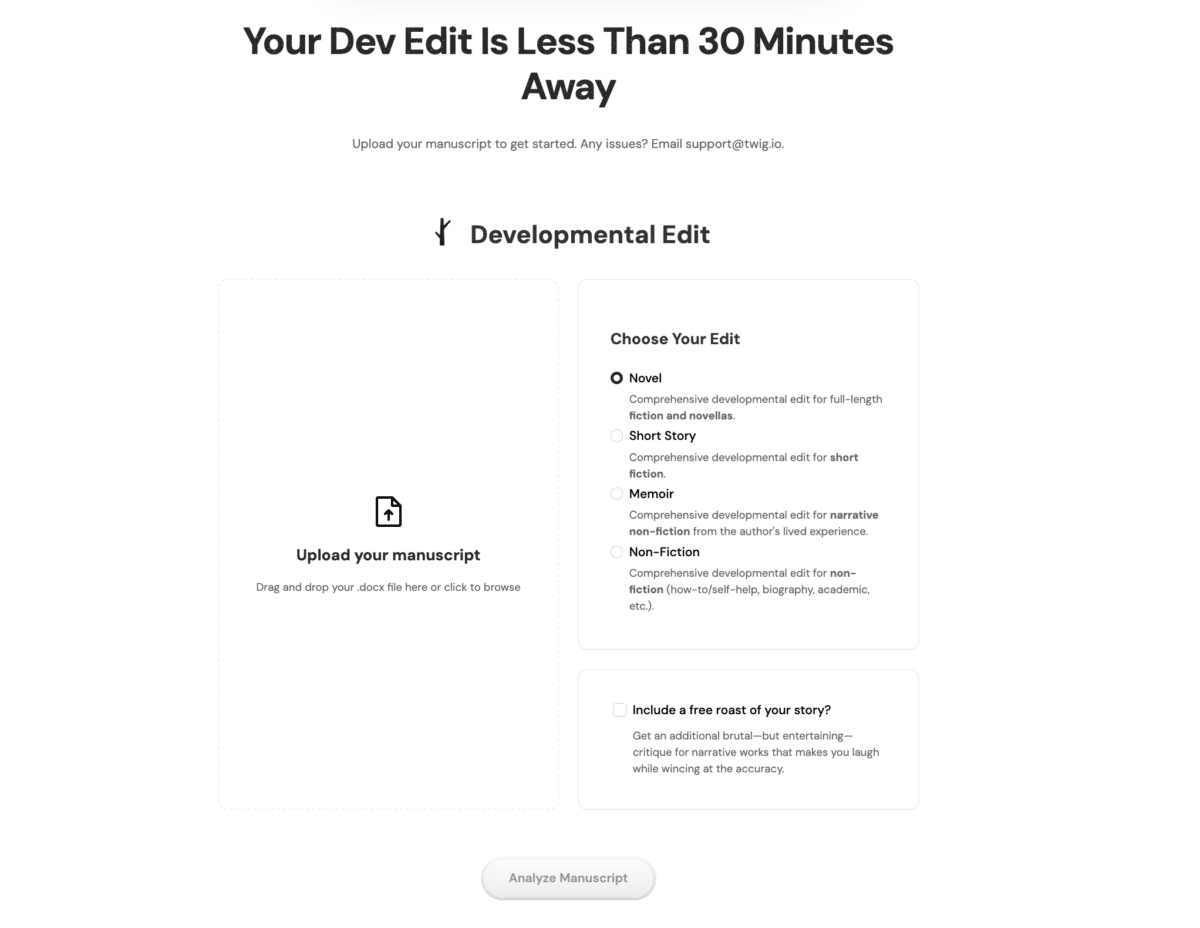
How I Personally Use Twig’s Dev Edit
As someone who has written more than 20 books myself and also has coached thousands of writers, I know the developmental editing process from both sides of the red pen.
So when I first heard about Twig, I was skeptical. Could AI really understand the nuances of story structure, character development, and writing voice?
Then I looked at the 27 different analyses that Twig runs on a manuscript, and honestly, I was impressed. Imagine a human reading your manuscript 27 different times with just one focus for each read-through. But it’s still a machine. I wasn’t sure it would be able to really comprehend my literary genius.
Finally, I ran my latest novel manuscript through the dev edit. For this book, I’ve been kind of stuck, especially with the rules of the supernatural elements and the arc of the protagonist. I knew there were problems. I even knew what most of the problems were. But I wasn’t quite sure how to fix them.
About 13 minutes later, I got my dev edit back, and I was shocked. Not only did Twig identify the same issues that I already knew I was struggling with, it also highlighted specific scenes where those issues popped up and gave me a step-by-step plan to fix them.
For example, here’s what it said about my ending:
The manuscript's final third (approximately Chapters 23-27) deteriorates in quality. The narrative becomes rushed, fragmented, and contains incomplete scenes and placeholder text. The climax and resolution feel underdeveloped and lack the emotional and narrative weight of the setup.
Well crap.
It even spoke to something I’ve wrestled with since starting this book, the genre and protagonist's age, saying the book “straddles the line between Young Adult and Adult literary fiction.” While I like straddling that line, I love how Twig identified something I’ve personally wrestled with for months!
What made this so useful though was that Twig pointed to specific places in my manuscript where that problem showed up and gave me suggestions to fix those things, which will make the revision process much faster.
And beyond the major things, there were dozens of helpful suggestions in the chapter notes, so I had a plan to not only make the book as a whole stronger but also to make each chapter better too.
When I compare this to previous experiences waiting weeks for developmental feedback (and paying a lot more), I appreciate how Twig can help maintain my writing momentum after finishing a draft.
While I will definitely still use a (human) developmental editor in the future, I will do at least one or two rounds of editing with Twig first.
So that’s how I’m using Twig. Now, let’s take a step back and talk about what Twig is and how it might help you get your book publish-ready.
In this post, I'm sharing my Twig dev edit review to help you decide if this virtual developmental edit could become the first step after you finish your book.[/quote]What is Twig’s Dev Edit?
Twig is a developmental editing tool powered by AI and designed to help writers get the step-by-step feedback they need to revise their next draft.
If you’re not familiar with a developmental edit, it’s when you get feedback on your book’s content, structure, and flow, rather than grammar or spelling.
Developmental edits are the best way to learn about what’s working and what’s not working in your writing, and at The Write Practice we always recommend them to first-time authors (and experienced writers as well).
The problem is that while worth it, they can be expensive, and often take weeks or even months to perform.
Twig, on the other hand, is about 1/10 of the cost, at $0.3¢ per word, and can be run in 30 minutes or less, giving you the feedback you need right when you want it.
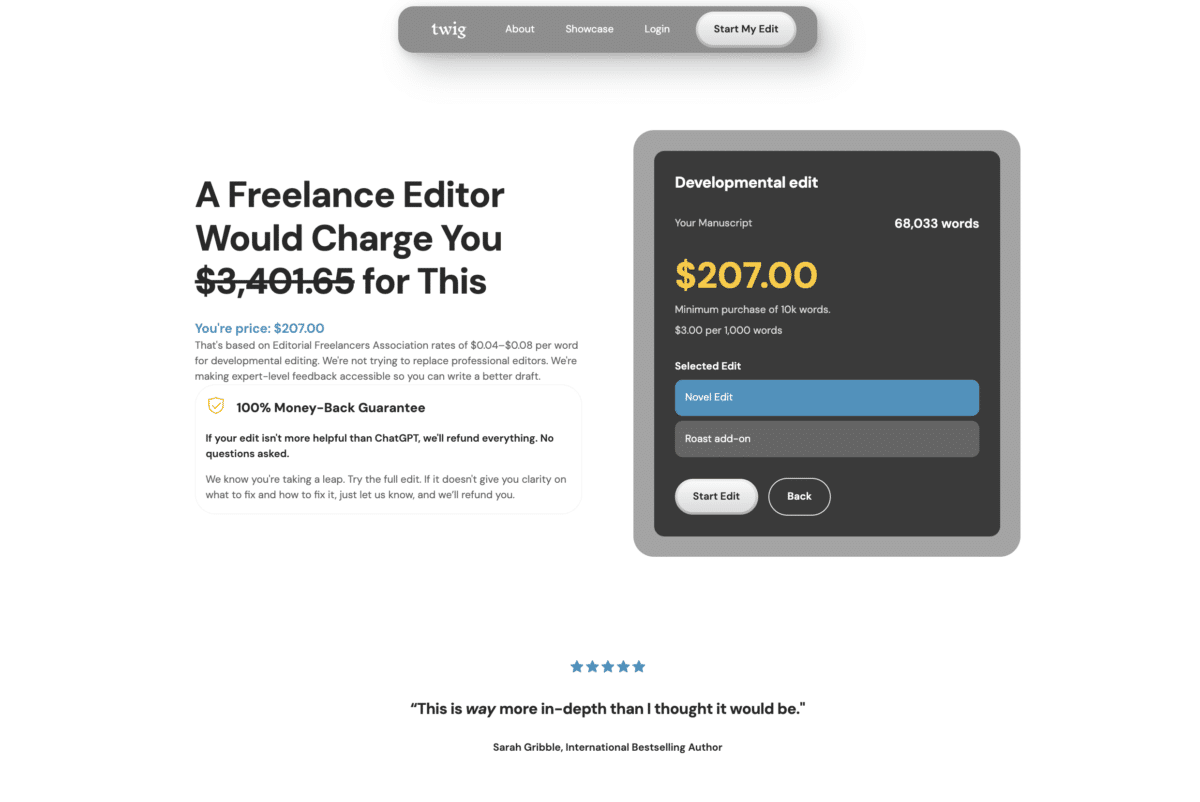
Twig's Pricing
Twig runs your manuscript through up to 27 different analyses focused on elements like structure, character development, pacing, emotional resonance, and genre expectations. Then, it compiles all of that into an editorial letter, chapter-by-chapter notes, and a detailed revision plan.
Also, one thing that makes it better than generic AI models like ChatGPT or Claude is that your writing stays private and is never used to train AI models.
How does Twig.io work, though? And will it help you with your specific manuscript? Let's talk about that next.
How Twig Works: The AI Edit’s Main Features
Twig behaves much like a normal dev editor, except much faster and less expensive. Here are the key features:
1. Editorial Letter
The cornerstone of Twig's feedback system is the Editorial Letter. Here you’ll get a broad overview of exactly what's working with your manuscript, what isn't, and why.
The feedback is organized into three clear priority levels:
- Critical Areas: These are the most significant issues holding your manuscript back.
- Important Areas: Secondary issues that would significantly improve your manuscript if addressed.
- Minor areas: Smaller suggestions that add polish once the bigger issues are resolved.
One thing that’s really good about Twig is that IF there aren’t major issues, it will tell you.
For most AI tools, especially the generic models like ChatGPT or Claude, it will always find something to correct.
Twig takes a different approach, only showing you the problems if it’s right for your manuscript, so you can trust you’re making actual progress in your revision (this is especially important if you use Twig for multiple rounds of edits).
The other thing that makes the editorial letter particularly useful is how it connects to the other elements of the feedback. Each issue identified in the Editorial Letter later gets fleshed out by the revision plan, and then explored in even more detail in the chapter notes, so it’s a comprehensive process.
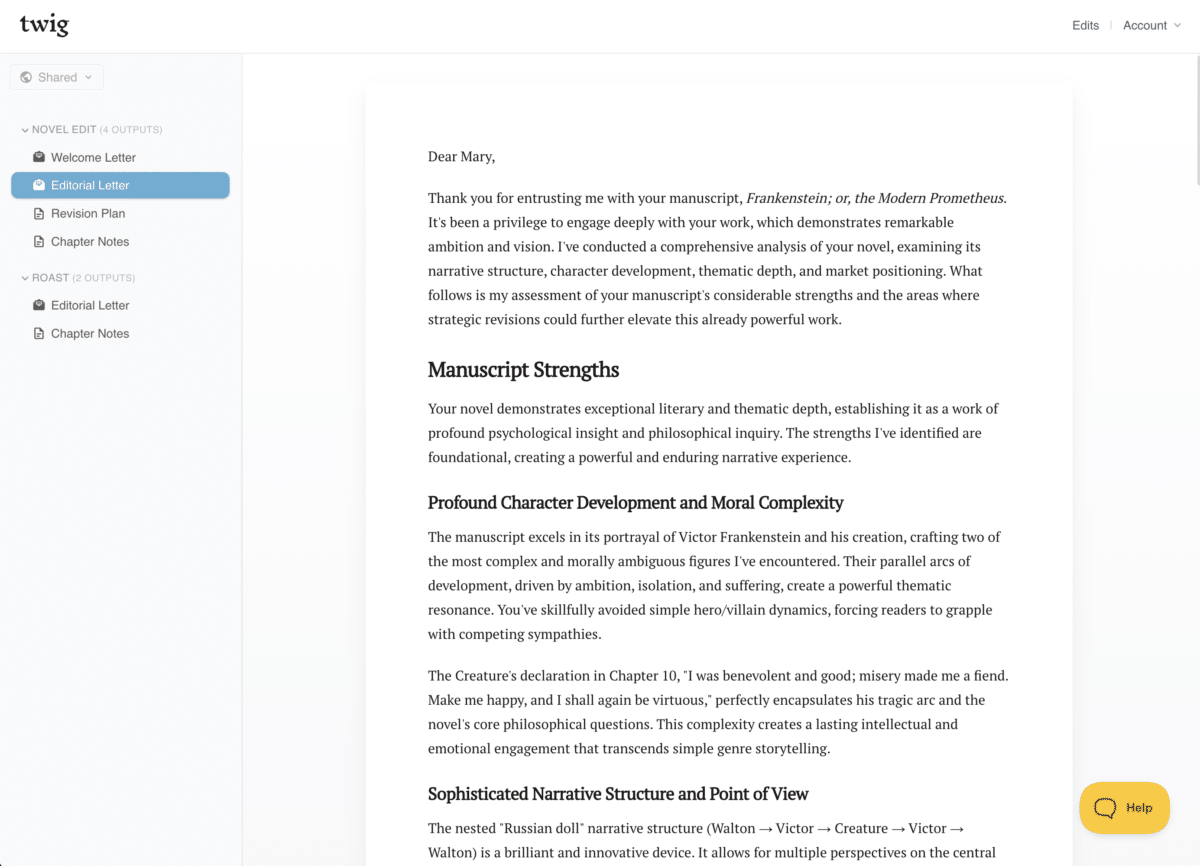
Editorial letter
2. Step-by-Step Revision Plan
If you've ever received feedback telling you what's wrong with your manuscript but not how to fix it, you'll like Twig's Revision Plan.
This feature takes the Editorial Letter and turns it into specific steps, including:
- A detailed explanation of why this matters to your manuscript
- Specific chapters and scenes where changes should be made
- Suggestions and ideas on how to implement those changes
Of course, not all of the suggestions are perfect or what you’ll end up doing, but that’s true for any kind of feedback you get as a writer.
The important thing is that instead of spending days figuring out which scenes to revise, you’ll have a roadmap that can take you directly to the specific parts of your book that most need work.
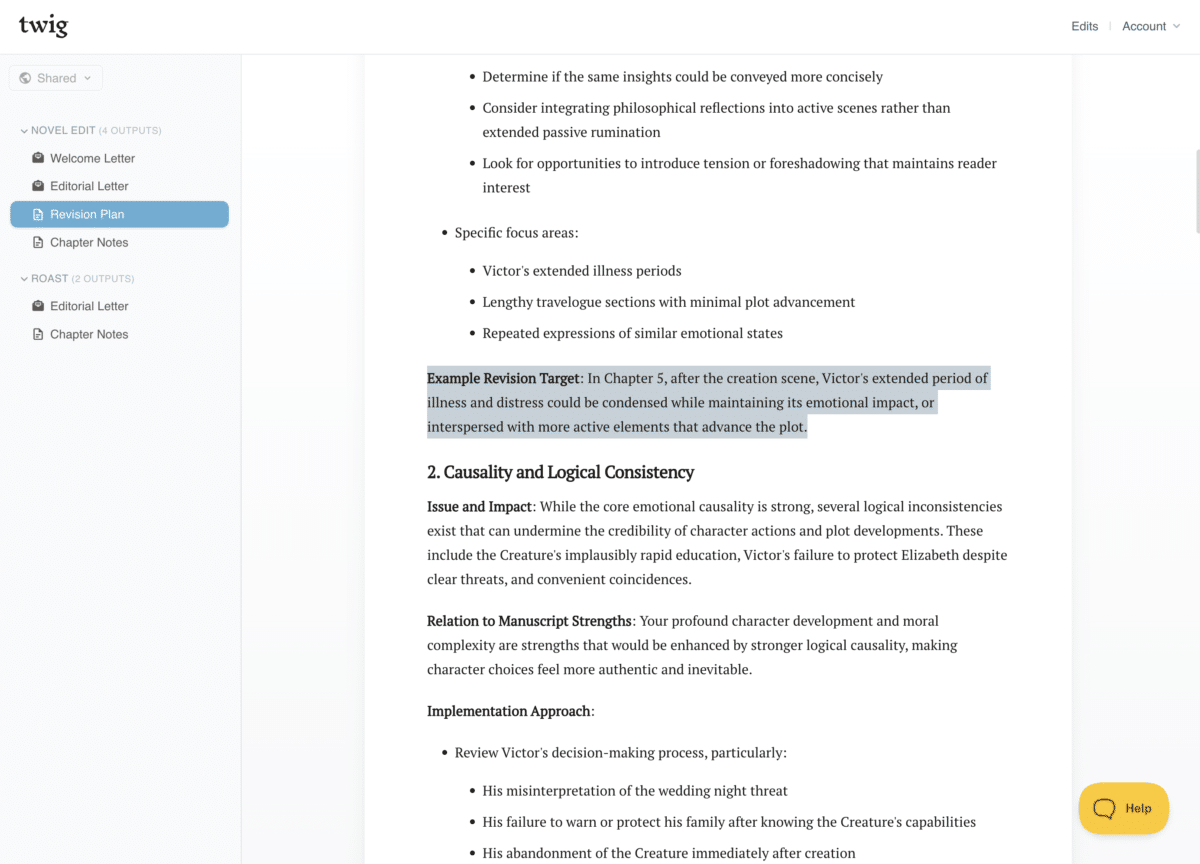
Revision plan.
3. Detailed Chapter-by-Chapter Analysis
The third major component of Twig's developmental edit is its chapter-by-chapter analysis. This feature dissects your manuscript one chapter at a time, then gives you specific feedback on what’s working, what isn’t, what to keep, and what to revise.
The chapter notes are broken into several sections:
Overview: A summary of the content and overall purpose of the chapter.
Strengths in This Chapter: A list of things that the chapter is doing well, from pacing to story arc to writing style.
Critical Areas for Attention: The most important things to fix in the chapter. Note that Twig may identify this as “None,” if it’s a particularly strong chapter (which is nice!).
Enhancement Opportunities: Other important or minor-level revisions you might consider for the chapter.
Revision Priorities: A mini-revision checklist for that specific chapter.
Preservation Notes: What to absolutely keep in the chapter.
Connections to Other Chapters: The elements that connect to future chapters.
What makes this feature especially useful (and different) from the other two components is that it often identifies issues that might not come up in the full editorial letter and revision plan, giving you a chance to polish your manuscript from a chapter-by-chapter level.
For example, when I ran a historical fiction manuscript through Twig, the chapter notes revealed inconsistent character voice in three specific chapters—something I might have missed even after multiple readings.
I will note that this is where I occasionally spotted minor inaccuracies in Twig's analysis. In a few instances, it misidentified character relationships or confused similar character names. However, these errors were relatively minor and didn't diminish the overall value of the feedback. For writers who struggle with revision planning, these chapter-by-chapter notes offer a methodical approach to tackling what can otherwise feel like an overwhelming task.
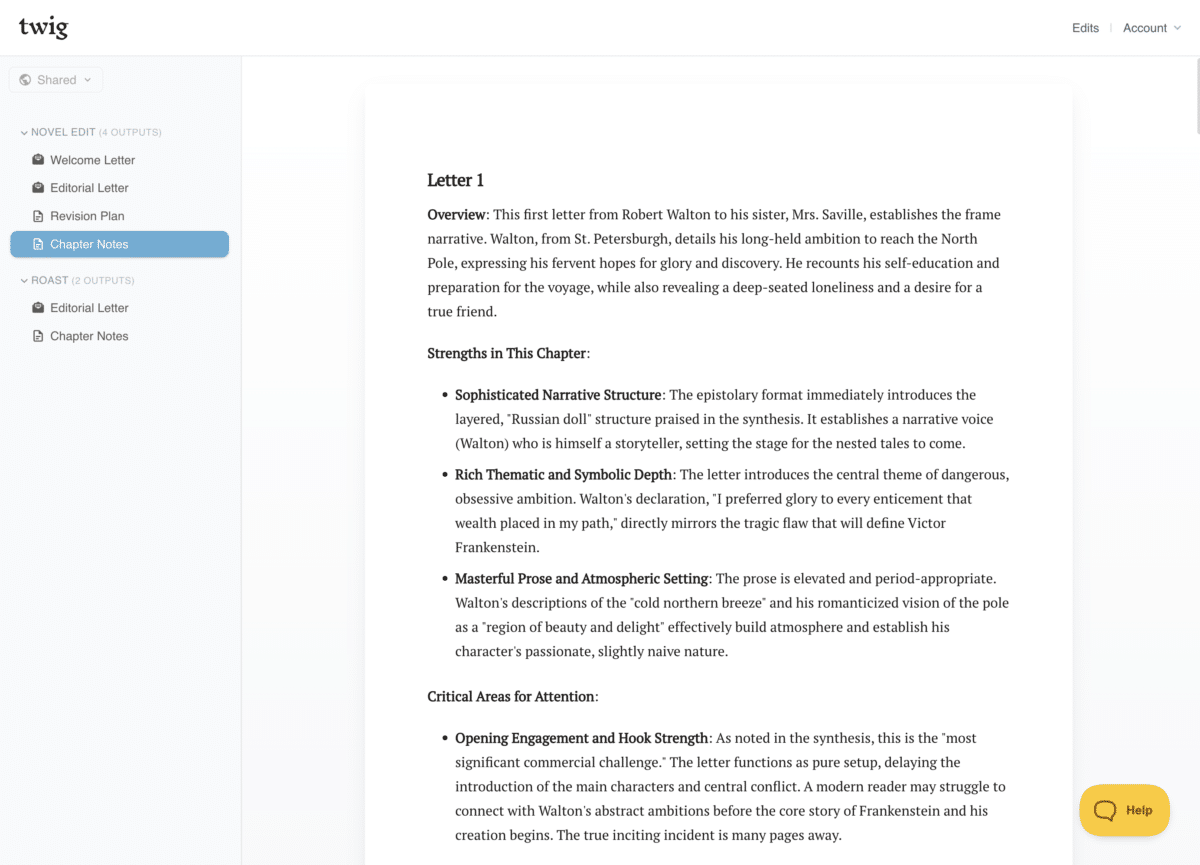
Chapter notes.
4. The Bonus Roast
One feature that sets Twig apart is its optional “Roast” mode (though they're considering renaming it “Honest Feedback”). This provides a more direct, unfiltered version of the editorial letter and chapter notes, delivered with humor but also brutal honesty.
While this might sound intimidating, many writers in our community have found it surprisingly helpful. When I was stuck on a particularly challenging section of my novel, the direct approach of the Roast helped cut through my resistance and see the problem clearly.
As one writer in our Pro community put it: “Sometimes you need someone to just tell you exactly what's wrong without sugar-coating it. The Roast did that for me, and I finally fixed the ending that had been bothering me for months.”
This feature is completely optional and comes at no additional cost, so you can decide whether or not this approach works for your revision style.
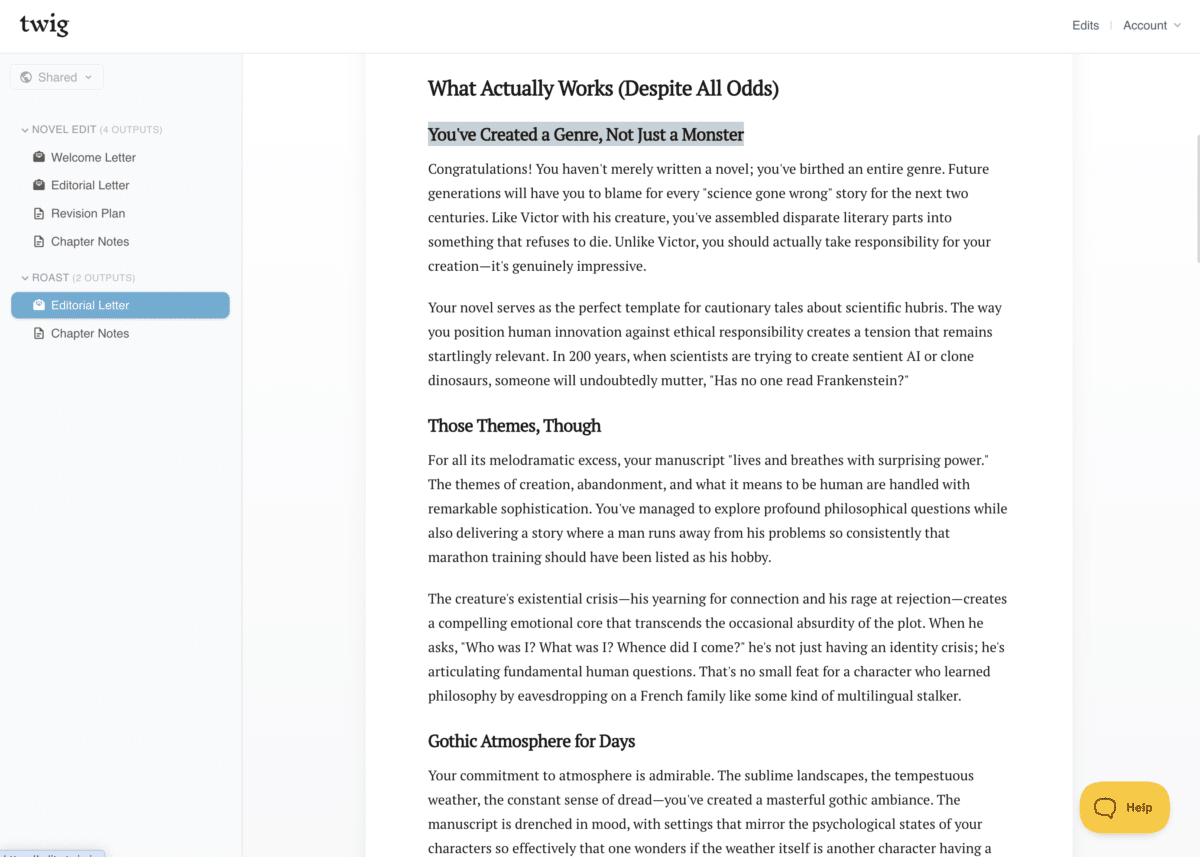
Twig's optional bonus roast.
5. Genre-Specific Analysis Framework
What truly distinguishes Twig from other AI writing tools is its specialized analysis frameworks tailored to different types of books. Rather than applying a one-size-fits-all approach, Twig analyzes your manuscript differently depending on whether you're writing a novel, memoir, or nonfiction book.
For novels, Twig examines elements like:
- Character development and arcs
- Plot structure and pacing
- Point of view consistency
- Emotional resonance
- Genre expectations
For memoirs, it focuses on:
- Narrative voice and authenticity
- Emotional journey
- Theme development
- Truth and vulnerability
- Reader engagement
For nonfiction, it evaluates:
- Clarity and organization
- Persuasiveness and evidence
- Audience appropriateness
- Actionability of advice
- Unique contribution to the field
This specialized approach means Twig can provide insights that are actually relevant to your specific type of book, rather than generic writing advice.
Pros and Cons of Twig.io
As with any writing tool, Twig has its strengths and limitations. Let's break them down:
Pros:
- Rapid Feedback: Receiving comprehensive developmental feedback in 30 minutes (versus weeks with human editors) helps maintain creative momentum during the revision process.
- Cost-Effectiveness: At approximately one-tenth the cost of traditional developmental editing ($150 vs. $1,500+ for a 50,000-word manuscript), Twig makes professional-level feedback accessible to more writers.
- Actionable Suggestions: Rather than vague feedback, Twig provides specific locations and concrete suggestions for improvements.
- Privacy Protection: Your manuscript is never used to train AI models, addressing a major concern for writers considering AI tools.
- Excellent Customer Support: In my experience, Twig's support team responds quickly to questions and is genuinely interested in hearing about user experience and feedback for improving the service.
Cons:
- Occasional Inaccuracies: While generally accurate, Twig sometimes makes minor mistakes, particularly in the chapter-by-chapter notes (misidentifying characters or confusing similar names).
- Limited Nuance for Experimental Writing: If your manuscript deliberately breaks genre conventions or employs unusual techniques, Twig may flag these as issues rather than recognizing them as intentional stylistic choices.
- Learning Curve for Feedback Implementation: While the feedback itself is clear, determining which suggestions to implement and which to ignore requires some editorial judgment.
- More Expensive Than General AI Tools: Though significantly cheaper than human editing, Twig costs more than general AI tools like ChatGPT or Claude (though it provides much more specialized analysis).
- Not a Substitute for Human Connection: While excellent for structural and developmental feedback, Twig can't replace the mentoring relationship or personalized guidance that some writers need.
Is Twig.io Right for Me?
Twig.io is particularly well-suited for certain types of writers and specific situations.
Twig.io will particularly benefit:
Writers on a Budget: If professional developmental editing is financially out of reach, Twig provides a more affordable alternative without sacrificing quality.
Self-Published Authors: If you're working on tight deadlines and managing your own publishing schedule, Twig can dramatically accelerate your revision process.
Writers Preparing for Professional Editing: Using Twig as a first pass before hiring a human editor allows you to address major structural issues, so your paid editor can focus on deeper, more nuanced aspects of your manuscript.
Writing Groups and Beta Readers: Twig can supplement feedback from writing groups by providing structured, objective analysis that peers might miss.
Experienced Authors: If you've published multiple books and understand developmental editing principles, Twig can serve as an efficient revision tool that helps you spot blind spots in your own work.
Twig will help you if:
- You've completed a full manuscript and need substantive feedback
- You want to identify structural and developmental issues before moving to line editing
- You're seeking specific, actionable revision guidance rather than vague feedback
- You need feedback quickly to maintain your creative momentum
- You want to make the most of any investment in human editing by addressing major issues first
Twig is less suitable for:
- Writers still drafting their manuscript (finish your first draft first!)
- Authors seeking line editing or proofreading (consider ProWritingAid for those needs)
- Writers who strongly prefer human interaction throughout the editing process
- Authors of highly experimental works that intentionally break conventional structures
Comparable Alternatives
While Twig offers a unique combination of features, there are other approaches to getting developmental feedback:
Traditional Developmental Editing
Human developmental editors provide personalized guidance and can adapt to unique writing styles and experimental approaches. However, they typically charge $0.03-0.05 per word ($1,500-2,500 for a 50,000-word manuscript) and may have waiting periods of weeks or months.
Best for: Writers who want a relationship with their editor and need highly personalized guidance.
Writing Groups and Beta Readers
Peer feedback from writing groups or beta readers can provide valuable insights and is typically free or based on reciprocal feedback. However, the quality varies significantly, and feedback may lack the structured, comprehensive analysis that professional editing provides.
Best for: Getting reader reactions and spotting obvious issues, especially when used alongside more structured feedback.
General AI Tools (ChatGPT, Claude)
While less expensive (or free), general AI tools aren't specifically designed for book-length developmental editing. You'll need to create your own prompts and may receive less detailed, less structured feedback than Twig provides.
Best for: Quick feedback on short excerpts or specific writing questions.
AutoCrit
AutoCrit ($30/month or $297/year) focuses more on line-level issues like word choice, pacing, and dialogue, with genre-specific analysis based on successful books in your category. However, it doesn't provide the comprehensive developmental feedback and structured revision plan that Twig offers.
Best for: Writers looking for help with line-level issues rather than big-picture developmental feedback.
ProWritingAid's Manuscript Analysis
In addition to its grammar and style checker, ProWritingAid now offers a virtual Manuscript Analysis that uses AI to assess big-picture issues and deliver actionable feedback across your manuscript. However, it doesn’t include a genre-specific analysis framework and is less ideal for memoir and nonfiction.
Best for: Budget-conscious fiction writers who want big-picture feedback once their draft is complete.
Final Verdict on Twig.io
After testing Twig.io extensively with my own manuscripts and observing its impact on the work of writers in our community, I can confidently say: Twig.io is worth it for authors with completed manuscripts who want professional developmental feedback without the high cost or long response times of traditional editing.
What impresses me most about Twig isn't just what it tells you about your manuscript but how it guides you through the revision process with specific, actionable steps. For many writers, this structured approach to revision can be the difference between a manuscript that languishes in endless revisions and one that reaches its full potential.
The combination of detailed feedback, specific action steps, and quick response times at a relatively accessible price makes Twig an exceptionally valuable addition to a writer's toolkit.
As one of our community members, Sarah, a literary fiction writer, put it: “After using Twig, I finally understood why my manuscript kept getting rejected. The issues were there all along—I just couldn't see them. Within three weeks of implementing Twig's suggestions, I had an agent request my full manuscript.”
Twig's 100% money-back guarantee also makes it a risk-free decision. At worst, you'll lose 30 minutes. At best, you might just transform your manuscript and your revision process.
Have you tried Twig or other AI virtual dev edit tools tools? I'd love to hear about your experience in the comments below.
PRACTICE
Today, let's practice developmental editing. Find a story or piece of writing you've been working on. Then, set the time for fifteen minutes and edit your writing, looking at the big-picture issues like structure, characterization, and pacing. Don't worry about grammar or punctuation—just think about the larger, structural elements.
If you aren't working on anything right now, take five minutes to write a scene based on one of these prompts: Top 150 Short Story Ideas. Then, spend ten minutes editing your writing and highlighting different structural or content issues you'd like to change.
When your time is up, share your practice in the Pro Practice Workshop here. And if you share, please leave feedback for your fellow writers.
Not a member yet? Join us here.
Happy writing!

Joe Bunting is an author and the leader of The Write Practice community. He is also the author of the new book Crowdsourcing Paris, a real life adventure story set in France. It was a #1 New Release on Amazon. Follow him on Instagram (@jhbunting).
Want best-seller coaching? Book Joe here.

0 Comments