
What brings you to this article, adventurer? Ah yes, I know why you’re here. You’re here to learn how to write a tabletop role-playing game (TTRPG). Well, lucky for you, I have decades’ worth of GM experience, as well as extra advice from some other GMs in my community. Join me today as we look at how to write these stories.
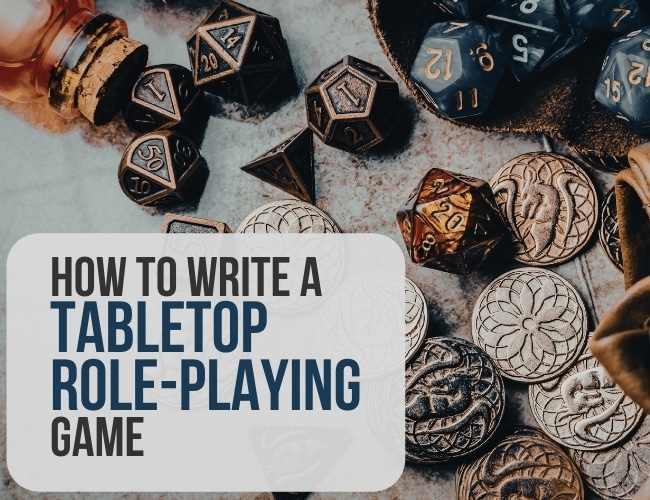
Today's article is by Jake Strife, a certified Write Practice book coach and the author of more than twenty-six novels. Welcome Jake!
“You enter the Dragon Tale Tavern, glad to be out of the storm.
The tantalizing scent of roast fowl fills the crowded, lively room. Every table occupied. Every patron drinking merrily.
No one pays you mind.
A group of dwarves sing drunkenly, prompting an elf to stand and shout, ‘Quiet down! I’m trying to study my spells!’
Dancing atop the bar is a gnomish bard with crazy blue hair and bright rainbow garb. She plays a mournful tune on her lute. Its enchanting notes don't match the joy most patrons are feeling, yet a group before her watches unblinkingly.
You briefly meet eyes, and she winks three times, confirming your companions are in position.
Lightning flashes through the dirty windows, and you spot your mark. Hooded and alone, the wizard is in a corner surrounded by an unnatural darkness, reading a scroll of parchment.
Before you move, a tipsy dwarf staggers into your path, followed by a huge green-skinned, tusked man in armor. He brandishes an axe. The dwarf continues to sing, not noticing the threat.
Getting involved will certainly alert the guard.
But if you don’t, the dwarf will die.
Either way, your mark has noticed you and is trying to escape out the back door.
What do you do?”
What is a Role-Playing Game?
Welcome, adventurer, to the world of tabletop role-playing games—where fantasy, sci-fi, and/or horror govern adventures for you and a group of others. Usually friends.
There are players with player characters (PCs), who interact and make decisions that shape the world itself.
And then there’s the Game Master (GM).
The GM’s role is not only to play the part of the non-player characters (NPCs), or to keep the rules enforced. A GM’s main job is to tell a story. A story in which said players must take on the role of heroes (or sometimes villains).
What is one of these stories about, you ask?
That’s the best part. They can be about anything.
A story where a maniacal queen sends her dragon army to destroy a neighboring kingdom.
A story where the rival starship captain is racing your players toward the MacGuffin, which can control the fate of the galaxy.
Or even a story where cosmic horrors are set to descend from the outer limits of the universe to end humankind, and a group of everyday people must stop the cult summoning ritual, rationing both their sanity and their bullets.
In a way, it’s similar to writing novels. The players need a goal, threats along the way, and a climax with the BBEG (big bad evil guy/gal).
Of course, a lot like a novel, you as the GM can be a pantser and wing the story. This can work if you can think of entirely new plot points and exciting situations at the drop of a hat.
But thankfully, there are also rules to the game. There are monsters or enemies in books the GM can purchase, as well as make up on the spot.
So, what kind of story do you want to tell?
There are dozens, maybe hundreds, of TTRPGs. Heck, almost every pop culture IP seems to have one these days. Some of the most popular are Call of Cthulhu, a cosmic horror game; Cyberpunk, a sci-fi game with the same name as the genre; and the original game that started it all, Dungeons & Dragons, a fantasy role-playing game in the same vein as Tolkien’s Lord of the Rings.
Aside from the different rules in each of these games, and even different editions of each game, the thing that remains constant is the storytelling aspect—and the need to make sure everyone has fun.
It may seem intimidating to sit around a table with three to five or so friends (or sometimes complete strangers, if that floats your galleon), but this is where not winging it completely comes into play.
If you have your story ready to go, then you'll have a much easier time, and your players will thank you for it (usually literally—it's sort of customary to say thank you to the GM after a session, as it is a lot of mental juggling).
Thus, let’s get into it, shall we?
Writing a TTRPG
Writing a TTRPG is just like planning a novel. In fact, you can take The Write Structure course from The Write Practice and use the elements of structure as a skeleton for your epic tale, normally called a campaign.
The game needs the status quo, the inciting incident, all that happens between in the rising action, and the final climax with the villain, that if the heroes fail, not only can their characters die, but the world itself can fall into ruin.
It’s all up to you and the roll of the dice.
Rolling the Dice
The games typically use multi-sided dice to help make decisions and find results throughout the game. The dice correspond to sheets of paper that hold the information about each player’s character.
For instance, from the intro above, the poor drunken dwarf is about to be chopped in two. You, as the player, would roll a die and add numbers pre-generated on your character sheet.
Say you roll a normal die—a d6 (six-sided die). You roll a 5 plus a statistic number on your sheet, +3. So your total would be 8. Well, you draw your sword and try to slay the bad guy with the axe.
The GM then rolls a die, too. He rolls a 5, as well. But his statistic is a smaller number, +2. So he gets 7. Yours is higher, so you win.
You swing your sword and slash the baddie’s arm, and he drops his axe. He glares and shouts, “I will get my revenge!” and runs past you out the door and into the night.
That’s a simplified situation and dice setup. The players typically have read the rules for their specific game, as would the GM, so everyone mostly understands how that all goes.
But those are just the game mechanics.
The true meat and potatoes is the story.
Player Autonomy
One long-time GM gives this advice: “You guys write the story; I just make it complicated!” — PunkAzzMofo
This basically means the players are important in deciding what happens and where the story goes. Now, your story isn’t demolished just because players decide to go to the castle and fight the evil king instead of the cave to fight the dragon. It merely means a different moving part has taken precedence. Storytelling for TTRPGs isn’t always linear, which is great. You can write branching paths, and it can all still happen.
In this situation, they know there’s an evil king because you had to have told them. (If they make that information up, you could try to deter them by saying that the king is benevolent. In fact, he’s offering a large money reward to anyone who slays the dragon in the cave.)
It’s a storytelling game, so the players can still decide the king is evil and go after him. Or perhaps they are now motivated to go to the king, hear about the bounty on the dragon, and tell the king they will go slay the dragon and be back for their reward.
In either scenario, even if the players are driving the story in a direction, you still get to decide the final outcome and the threats along the way.
And if your players still try to slay the king, you can have guards overpower and throw them in the dungeon so they can stage an escape and reflect on their error.
The Dice Never Lie
Any dice rolls involved dictate specific beats. Say the players try to sneak past the guards. They roll a really bad number, and oops. They get captured.
PunkAzzMofo also has this saying: “The dice never lie!”
AKA dice rolls decide if the players fail or succeed. Definitely. So there’s no argument about which result happens.
The Importance of Collaboration
An aspect of storytelling in TTRPGs is that everyone collaborates. You may want one story, but remember, everyone should be having fun.
The best way to do this is to use the players’ ideas.
Another GM, Morphling, has this to say: “What they assume or theorize can reveal what they are interested in.” — Morphling
This way, by allowing players to assume—which they love to do out loud—you can change the story just from their fears or excitement.
A fear:
“Oh no. Behind that door has to be a zombie!”
(There was no zombie originally. But since the player is scared of that, you now say:)
You open the door. And a lumbering, rotting corpse reaches for you, teeth gnashing!
An excitement:
“I bet behind that door is a room full of treasure!”
You open the door. Inside, you find a pile of golden coins and shining gems overflowing from a treasure chest.
For even more fun:
As you kneel down to scoop up the gems, you hear a spine-chilling laugh. You slowly look up, and the treasure chest now has eyes and huge teeth. It lunges at you, its next meal.
In the last scenario, you both gave them what they wanted but added danger into the scene. Now they can have the gems, but they have to survive and defeat this living treasure chest (called a mimic).
Some GMs get a little power-hungry and forget the game is a collaboration between several different people with different ideas and different responses to situations. These GMs may not like that players went to go slay that king.
But this is something every GM should remember: “It’s not the GM vs. the Players—it’s a cooperative story being told for fun.” — Crossfire Nate
Everyone works together to have a good time.
You Control the World; The Players Control the Path
These are mere aspects of a single world, from one genre, in one game system (such as D&D). There are many more games out there. One for every type of person.
And as a GM, a writer of a TTRPG story, you bear a heavy burden. You are the entertainer. You control the NPCs, the monsters, the world itself.
The players control the path taken. But at the end of the day, just as with writing a novel, you decide what happens in response to your players. And you decide the overall antagonist and their goal.
And you decide where and when the final scene fades to black.
Don’t Forget to Have Fun
Don’t be intimidated. Writing for this game—be it premade stories you sell as actual RPG books, or a story you write in a notebook for a group of friends—is all about having fun.
Without realizing it, you may make the best friends of your lives just by playing these games.
And you create a world, a story, and memories that your players will carry with them forever. They will always remember the laughs, the scares, the joy of triumph, and the power of friends working together.
You are the GM. The Game Master.
You are the storyteller.
You just changed several people’s lives forever.
What's your favorite TTRPG? Have you ever written one yourself? Share in the comments!
PRACTICE
Using the intro tavern scene as an example, set the timer for 15 minutes and write a scenario as if you're telling a story to someone, with them being the main character (second-person perspective).
This works best if you get a friend or family member involved. (Alternatively, you can ask an AI questions if that's easier or more comfortable. However, peer-to-peer interaction is how you will grow in this area of writing).
Begin with the word “You” and describe to the person where they're at and what is happening around them. Then ask questions about what they would do next and tell them the results of their actions. Continue for 15 minutes.
Afterwards, you can post your practice in The Write Practice Pro workshops to show us your adventure! Remember, have fun.
Not a member on our writing community yet? Join us here.
Happy writing!

This article is by a guest blogger. Would you like to write for The Write Practice? Check out our guest post guidelines.


0 Comments